For generations of children, a trip downtown at Christmas meant something more exciting than shopping. Somewhere among the decorated windows, toy departments and twinkling lights was the person they really wanted to see: Santa Claus.
Department stores didn't invent Santa, but they helped transform him from a legendary Christmas visitor into someone children could actually meet. By creating elaborate holiday displays and inviting Santa into their stores, retailers helped establish a Christmas tradition that eventually spread to shopping centers and malls across America.
Before the Department Store Santa
By the early 19th century, the American image of Santa Claus was already taking shape. Stories, poems and illustrations were turning St. Nicholas into the cheerful Christmas Eve visitor familiar to children today.
But Santa was still largely someone children imagined.
Retailers began changing that.
Historical accounts describe merchants experimenting with live Christmas characters surprisingly early. According to HISTORY’s account of retail Santas, Philadelphia merchant James Parkinson hired a man to play Kris Kringle in 1841. This is an early retail appearance, rather than a documented first Santa photograph.
The spectacle attracted attention — exactly what a retailer hoped a Christmas promotion would do.
Santa Moves Inside the Store
During the second half of the 19th century, American retailing was undergoing a transformation. Large department stores were becoming destinations where shoppers could spend hours browsing merchandise, dining and enjoying elaborate displays.
Christmas offered stores an opportunity to create something even more theatrical.
Buildings were covered in decorations. Windows became miniature Christmas scenes. Toy departments expanded. Lights, music and seasonal displays turned shopping into entertainment.
Santa fit naturally into this new world.
HISTORY describes competing claims about the earliest department-store Santas, including accounts from the 1860s and James Edgar’s appearance in 1890. The linked Macy’s company timeline does not substantiate a Santa debut in 1861, so we do not use it to establish that date.
The Famous Santa of Brockton, Massachusetts
One of the best-known early department store Santas, described in HISTORY’s retail history, appeared in 1890 at Edgar’s Department Store in Brockton, Massachusetts.
Store owner James Edgar dressed as Santa himself.
Edgar was already known for enjoying costumes and entertaining children. His decision to appear as Santa proved enormously popular. Children reportedly traveled with their families to Brockton just for the chance to see him.
Edgar is sometimes described as the first department store Santa, although earlier retail Santa appearances are documented. What is clear is that his 1890 Santa became one of the most famous early examples of a store turning a meeting with Santa into a major Christmas attraction.
Other retailers quickly recognized the appeal.
Christmas Shopping Becomes an Experience
By the early 20th century, America's largest department stores were competing to create increasingly spectacular Christmas experiences.
The goal wasn't simply to sell toys or decorations. Stores wanted families to make visiting their Christmas displays part of the holiday itself.
Santa became the star attraction.
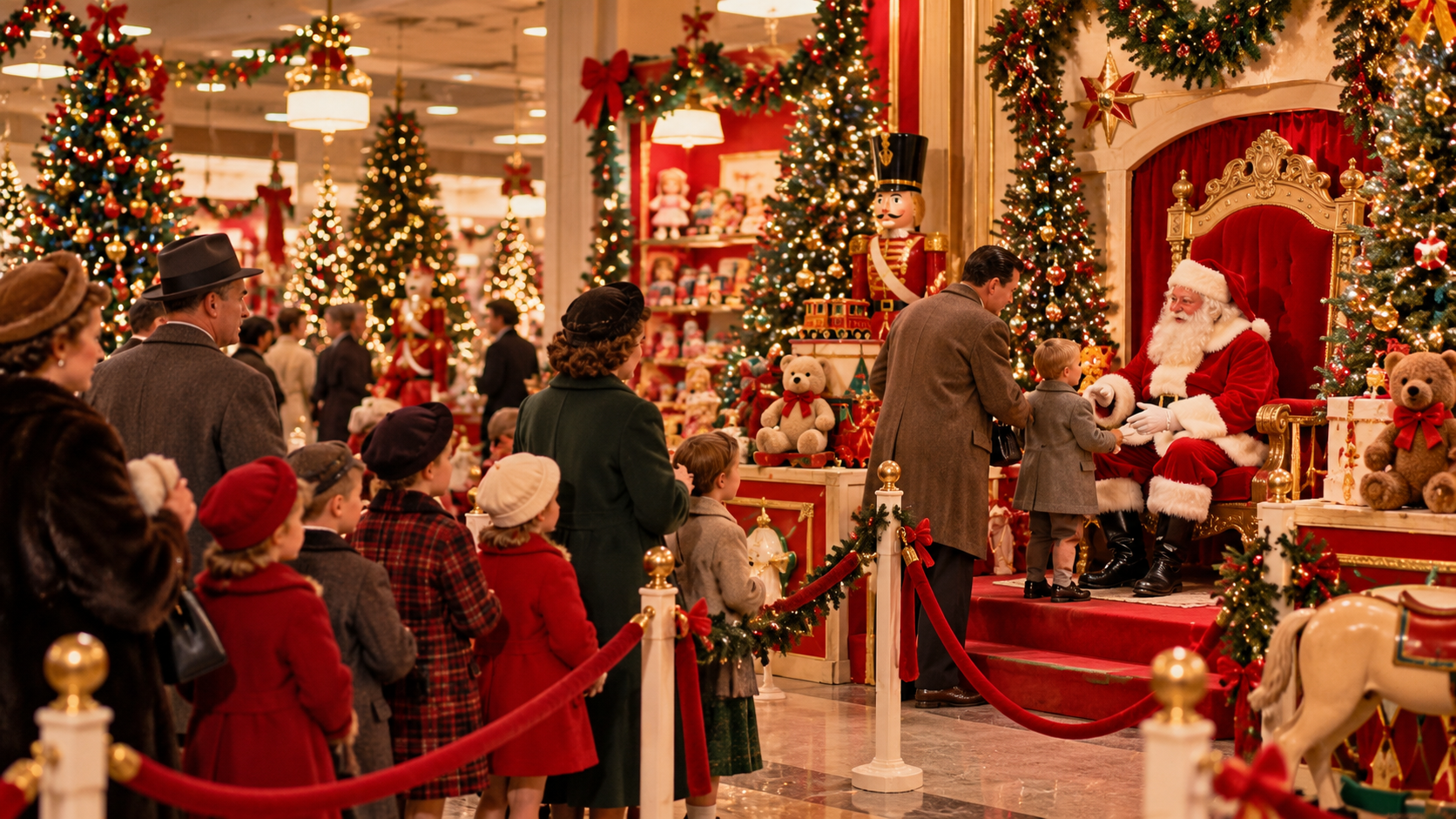
Instead of merely walking through the store, Santa increasingly appeared in a dedicated setting. He might sit on an ornate chair surrounded by Christmas trees, toys, artificial snow, elves and North Pole scenery.
Children could wait in line, approach Santa one at a time and tell him what they wanted for Christmas.
The department store had created something much more powerful than an advertisement: a family ritual.
Macy's and a Santa Known Across America
Few retailers became more closely associated with Santa than Macy's.
The Macy’s company timeline dates its first parade to 1924, the event that would become the Macy’s Thanksgiving Day Parade. Santa Claus appeared at the end, beginning a tradition that continues today.
For millions of families watching the parade, Santa's arrival became a symbolic announcement that the Christmas season had begun.
Macy's connection with Santa became even more famous through the 1947 film Miracle on 34th Street. The story of a Macy's department store Santa who claims to be the real Kris Kringle permanently linked the magic of Santa with the bustling Christmas department store in American popular culture.
The Rise of the Department Store Santa Photo
Meeting Santa was memorable. Taking home a picture made the experience something families could keep.
As photography became faster and more affordable, photographs increasingly became part of the Santa visit.
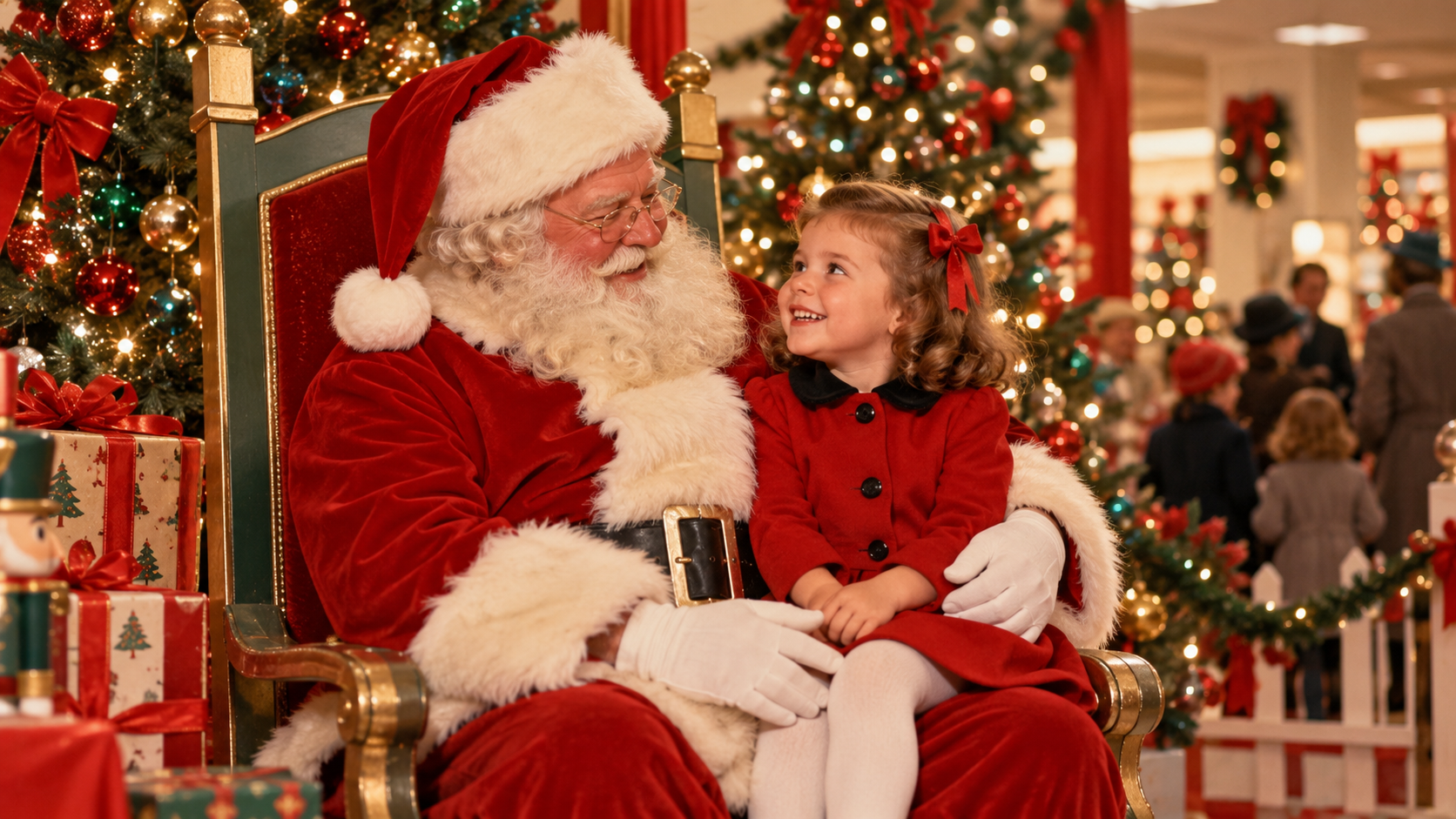
The familiar setup was ideal for a portrait: Santa seated in his chair, a child beside him or on his lap, Christmas decorations in the background and a camera directly in front.
Parents could leave the store not only with their Christmas shopping, but with a photograph documenting that year's visit.
Repeat the ritual every December and the photographs became a visual record of children growing up.
From Downtown Department Stores to Shopping Malls
After World War II, American shopping habits began changing.
Families increasingly moved to the suburbs, and shopping centers and enclosed malls followed them. The grand downtown department store was no longer the only place capable of creating an elaborate Christmas attraction.
Shopping malls adopted the Santa tradition enthusiastically.
Central courtyards became North Pole villages. Families followed winding lines through decorated sets. Professional photographers captured the moment. In many communities, visiting the mall Santa became as familiar a December tradition as decorating the tree.
The location had changed, but the basic experience created by the department stores remained remarkably intact.
Why the Tradition Lasted
The department store Santa succeeded because the experience worked on several levels at once.
For children, Santa was suddenly real enough to talk to.
For parents, the visit created a family memory — and eventually a photograph.
For stores, Santa brought families through the doors during the busiest shopping season of the year.
But the tradition ultimately became bigger than retailing. Families returned year after year because visiting Santa became part of how they celebrated Christmas.
A Department Store Idea That Outlived the Department Store
Many of the great downtown department stores that helped popularize the Santa visit have disappeared or changed dramatically.
Their Christmas tradition hasn't.
Santa still takes his place in shopping centers, community celebrations, Christmas attractions and countless family photographs every December.
More than a century after retailers discovered the magic of bringing Santa into the store, families are still lining up to meet him.
And somewhere nearby, there's almost always a camera waiting.
Read the Retail Timeline Without Confusing the Milestones
The dates answer different questions. Parkinson’s 1841 appearance concerns a live character in a shop. Edgar’s 1890 appearance concerns a memorable department-store attraction. Macy’s 1924 milestone concerns a parade. None of those dates, on its own, identifies the first souvenir Santa portrait.
This distinction matters when a retailer calls its Santa the “first.” Ask whether the claim refers to a costumed visitor, a seated attraction, a parade, or a photography service. Our Santa-photo article considers the keepsake separately.
Sources & Further Reading
Historical background for this article was researched using materials from HISTORY and Macy's.