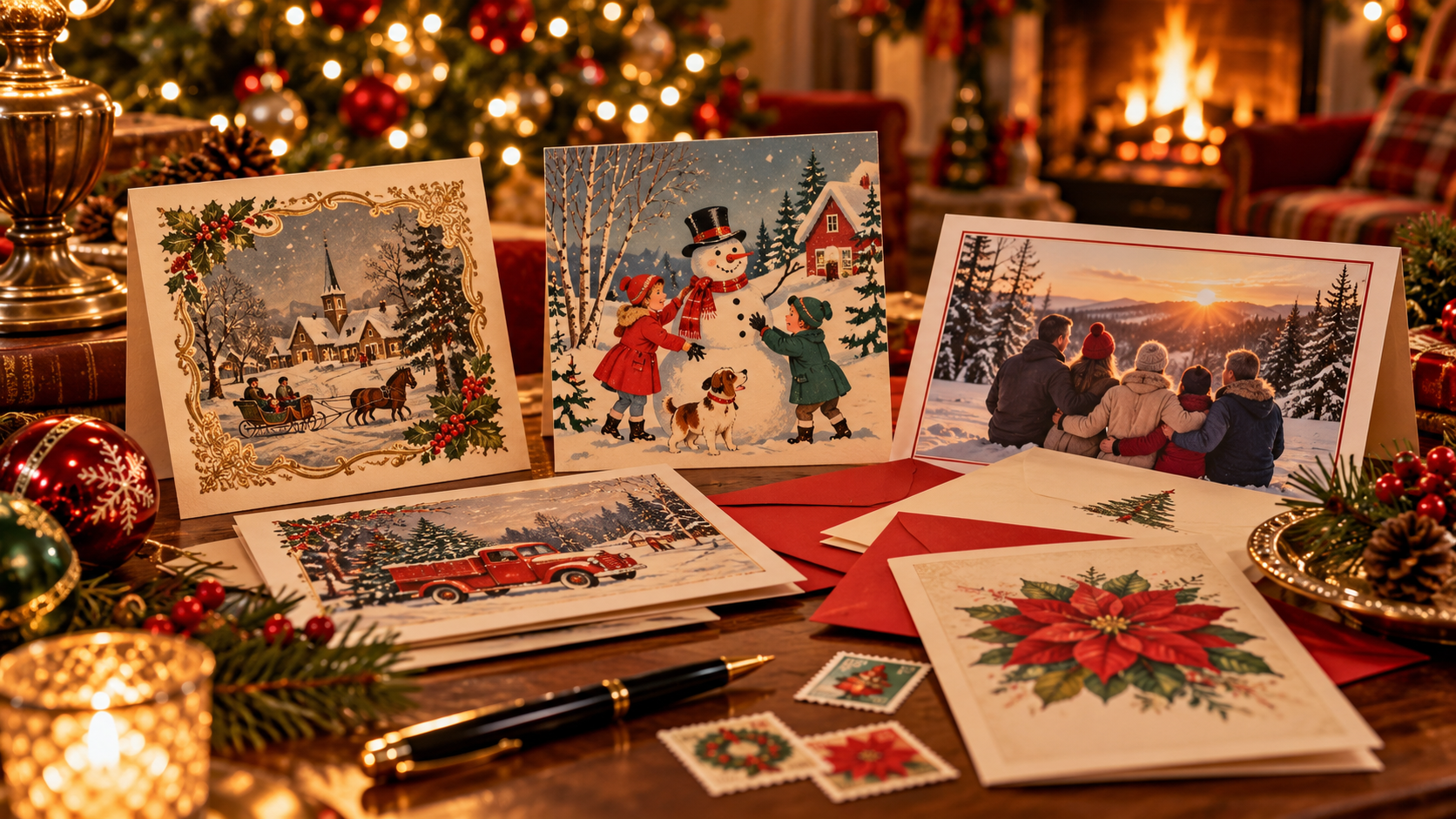
Before Christmas greetings arrived by text message, email or social media, December brought something much more tangible: envelopes filled with Christmas cards.
Some were elegant. Some were funny. Some featured snowy villages, Santa Claus or beautifully decorated Christmas trees. And many eventually featured something even more personal — a photograph of the family sending the card.
For generations, those cards accumulated on mantels, bookshelves, refrigerators and doorways, creating a temporary gallery of friends and relatives that appeared every Christmas.
The tradition began with a single printed card in Victorian England.
The First Christmas Card
The Victoria and Albert Museum’s account traces the first commercial Christmas card to Henry Cole in London in 1843.
Sir Henry Cole was a British civil servant, educator and prominent supporter of the new postal system. Like many busy people, he faced a familiar holiday problem: too many people to whom he wanted to send Christmas greetings and too little time to write individual letters.
Cole asked artist John Callcott Horsley to design a card that could be reproduced and mailed.
The resulting illustration showed three generations of a family celebrating together at a table, surrounded by smaller scenes depicting charitable acts.
Across the card appeared the greeting: "A Merry Christmas and a Happy New Year to You."
About 1,000 copies were printed. Cole could personalize the card with a recipient's name and send a Christmas greeting without writing an entire letter.
A new holiday idea had been born.
Cheap Postage Helps the Tradition Grow
The timing was ideal.
Britain's postal system was becoming easier and less expensive to use. The introduction of the Penny Post in 1840 made sending correspondence affordable to far more people.
Improvements in printing technology also made illustrated cards less expensive to produce.
By the second half of the 19th century, exchanging Christmas cards had become increasingly popular in Britain.
Victorian cards featured an enormous variety of designs. Religious scenes and winter landscapes appeared alongside flowers, birds, children, animals and occasionally images that would seem surprisingly strange on a Christmas card today.
As the custom spread, the Christmas card became a simple way to maintain relationships with people who might live far away.
Christmas Cards Come to America
The tradition soon crossed the Atlantic.
One of the important figures in the American Christmas card business was Louis Prang, a German-born printer who settled in Boston.
In the 1870s, Prang began producing elaborate Christmas cards using high-quality color printing techniques. His cards were admired for their rich illustrations and helped turn exchanging Christmas greetings into a popular American custom.
By the late 19th and early 20th centuries, Christmas cards were becoming a familiar part of the American holiday season.
Santa Finds His Way Onto the Christmas Card
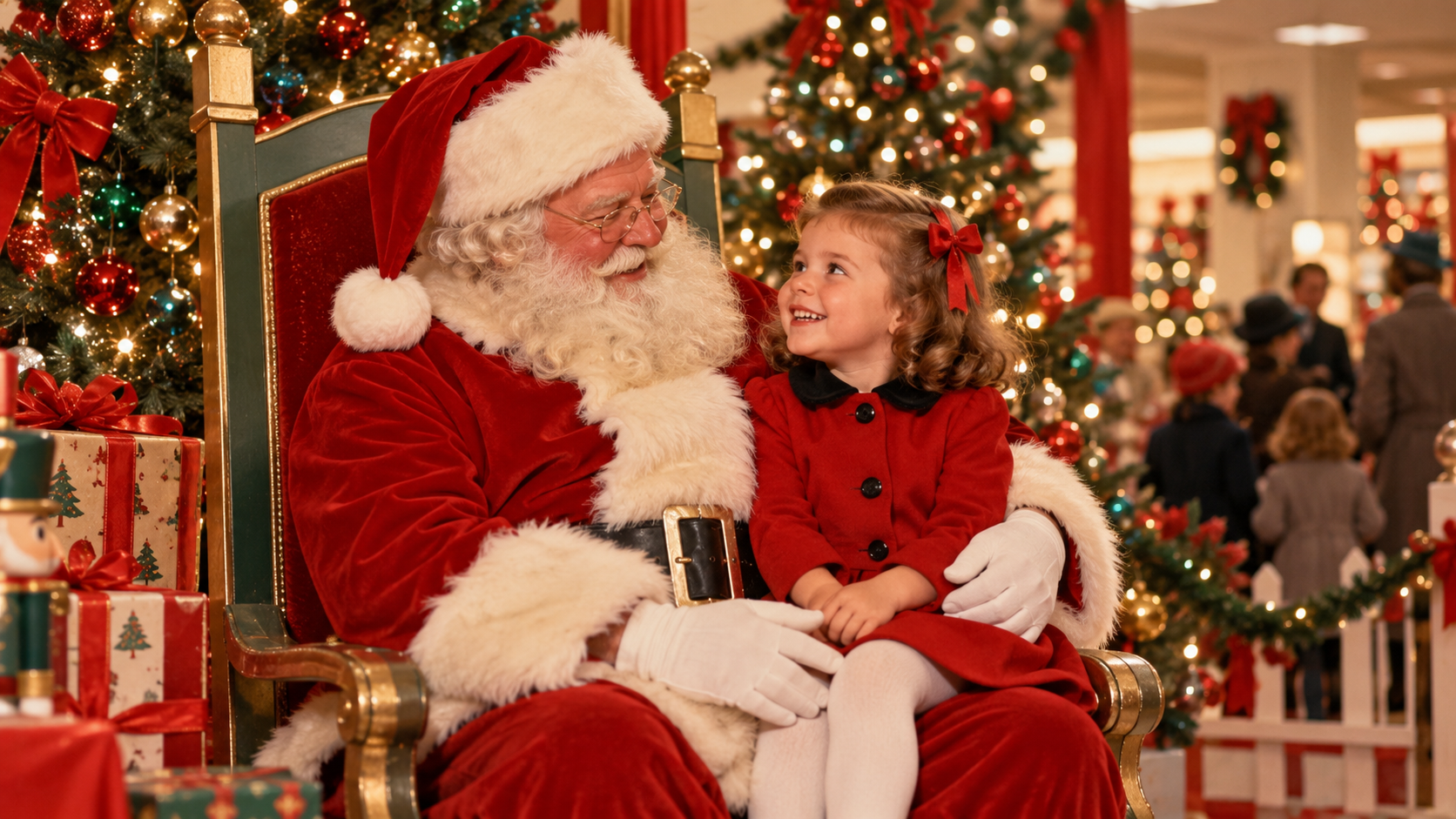
As the American image of Santa Claus became more standardized, he naturally became a favorite subject for Christmas cards.
Early cards showed Santa in many different forms. Some depicted him carrying toys through snowy villages. Others showed him arriving at the fireplace, filling stockings or surrounded by excited children.
By the early 20th century, Christmas cards were helping reinforce the familiar visual language of the holiday: Santa in red, decorated trees, snowy landscapes, stockings, toys and glowing fireplaces.
Sending a card wasn't just a greeting anymore. It was a small piece of Christmas artwork arriving in the mail.
Photography Makes Christmas Cards Personal
Eventually, families began putting themselves on the card.
Photography had become increasingly accessible during the late 19th and early 20th centuries, and photographic postcards offered people a new way to send personalized images through the mail.
Instead of choosing an illustration created by someone else, a family could send a photograph of themselves.
That changed the Christmas card in an important way.
The card was no longer simply saying, "Merry Christmas." It was also saying, "Here's how we look this year."
Children grew taller. Babies appeared. Hairstyles changed. Families moved into new homes. Pets joined the picture.
A stack of family Christmas cards could quietly become a visual history of a family over time.
The Postwar Family Christmas Card
A dated example makes the shift to photographic greetings more concrete: the Library of Congress holds a 1946 Christmas card from Charles and Ray Eames, showing the couple waving from inside an ornament or snow-globe setting.
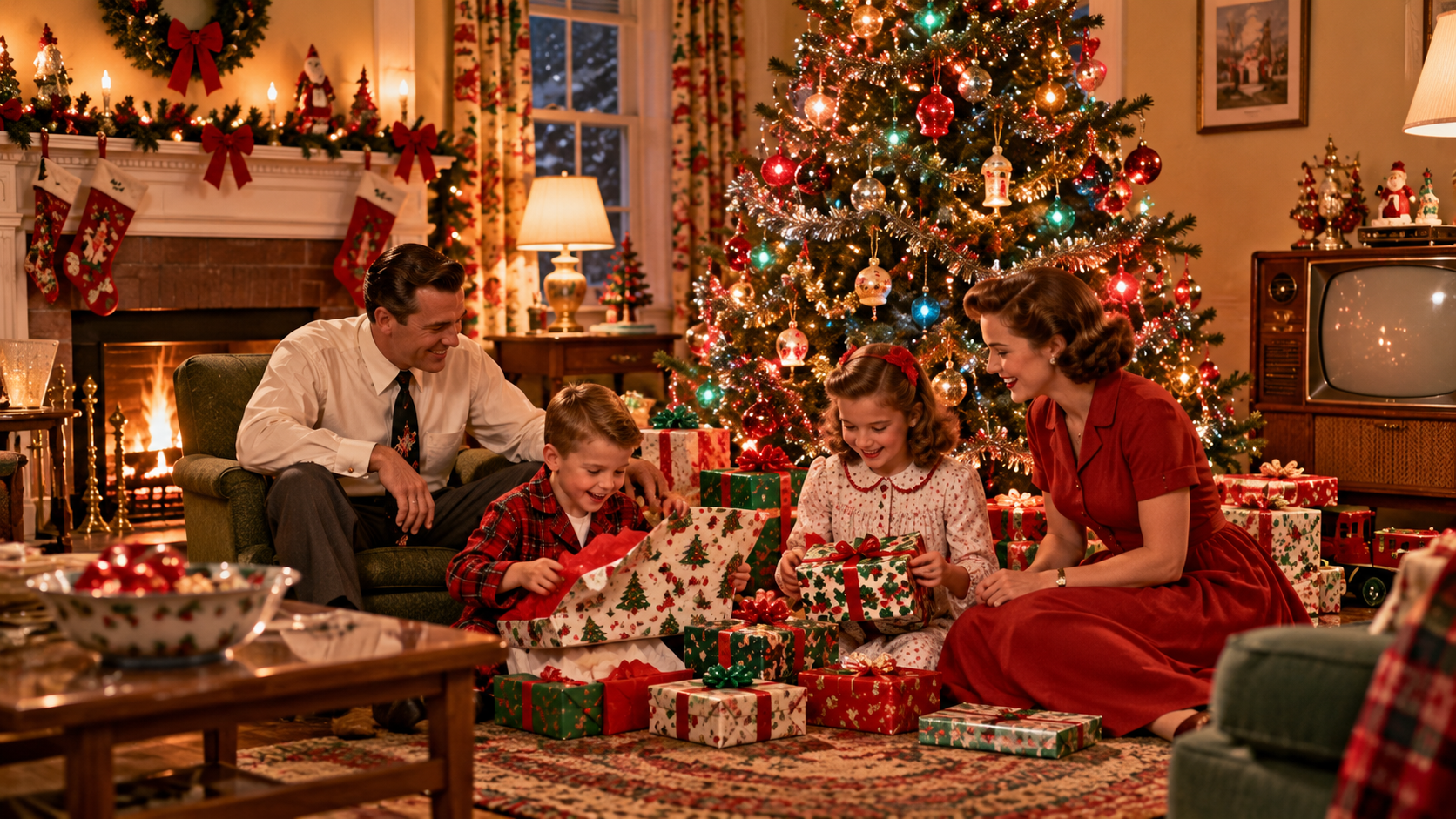
During the 1940s and 1950s, photography was becoming an increasingly ordinary part of family life. Cameras documented birthdays, vacations, new babies and Christmas mornings.
At the same time, Christmas card exchanges were booming.
Families could combine the two traditions by choosing a favorite photograph and turning it into the year's Christmas greeting.
Some families posed formally in their best clothes. Others stood beside the Christmas tree or gathered around the fireplace. Children might wear matching outfits. The family dog occasionally cooperated.
And when the photograph didn't go exactly as planned, that often made the card even more memorable.
The Christmas Letter Joins the Envelope
For many families, the Christmas card eventually gained a companion: the annual Christmas letter.
A short note could summarize the family's entire year — vacations, graduations, weddings, new jobs, new homes and the accomplishments of children and grandchildren.
For distant relatives and old friends, the yearly letter provided a way to stay connected long before social media made everyday updates instantaneous.
Some letters were only a few sentences. Others became impressively detailed annual reports.
Either way, opening the mailbox in December meant discovering what had happened in the lives of people you might not have seen all year.
The Refrigerator Becomes a Christmas Gallery
Receiving a family Christmas card created another tradition: displaying it.
Cards were arranged across fireplace mantels, tucked around mirrors, taped to door frames or displayed in special holders.
As refrigerators became fixtures of American kitchens, magnets provided another convenient gallery.
By Christmas Day, a collection of cards could fill an entire wall or doorway.
The display was temporary, but it offered a wonderful visual reminder of the people connected to the household.
From Film Cameras to Digital Photos
Creating a family photo card once required considerably more planning than it does today.
A family had to take the picture on film, finish the roll, have it developed, choose the best photograph, order prints or cards, address the envelopes and get everything into the mail before Christmas.
Digital photography changed the process dramatically.
Families could take dozens — or hundreds — of photographs, immediately see which ones worked and design personalized cards on a computer.
Smartphones made it easier still.
Yet the basic idea remained exactly the same as it had been for generations: choose an image that represents your family and send it to the people you care about.
Why Christmas Cards Still Matter
Today, sending a Christmas greeting requires almost no effort. A message can reach hundreds of people instantly.
And yet printed Christmas cards haven't completely disappeared.
Part of their appeal may be precisely that they require a little more effort.
Someone chose the photograph. Someone selected the card. Someone addressed the envelope. And for a few weeks every December, that card may sit on a mantel or refrigerator rather than vanish into a stream of digital messages.
The technology has changed enormously since Sir Henry Cole mailed his printed greetings in 1843.
The purpose hasn't changed very much at all.
A Christmas card still says something wonderfully simple: We're thinking about you this Christmas.
What to Look for in an Old Family Photo Card
A family card has two records to read: the photograph and the greeting. Check the back, envelope, or inscription for a date and names. A postmark can date the mailing, but the photograph itself may have been taken earlier. Keep that distinction in your notes.
The Eames card demonstrates a photographic greeting in 1946; it does not establish when every household adopted photo cards. Its catalog also flags possible publication restrictions. View the original through the archive link rather than assuming an online historical image is free to reproduce.
Making a Modern Photo Card Without Losing the Faces
Choose the card layout before cropping your picture. A portrait image placed in a landscape slot may lose heads or feet; a layout that fits the whole image can avoid that tradeoff. Leave space for a greeting and keep lettering away from faces.
If you use a generated Santa portrait, inspect the result before ordering cards. Compare faces with your original photograph and look closely at hands, glasses, and clothing. A painted Christmas-card style is an illustration, and should be treated as a creative greeting rather than an authentic historical photograph.
Sources & Further Reading
Historical background for this article was researched using materials from the Victoria and Albert Museum, Smithsonian Magazine and the Library of Congress.